

Persistent Identifiers: basics, types, uses
What are Persistent Identifiers (PIDs)?
With Persistent Identifiers (PIDs), it is possible to reference, distinguish and link entities in the long-term. Such entities could be people, organizations, research data or objects, for example. The most widely known PIDs are DOIs for academic publications and ORCID iDs for identifying researchers. The international community around PIDs is constantly developing further areas of application.
A PID consists of unique character string that depends on the identifier system, an alphanumeric code. Such a string might look like this for instance: 10.34726/dig.17679401. Combined with a resolver system (here for a DOI, a PID for publications), you get a URL: https://doi.org/10.34726/dig.17679401.
This link leads to a landing page providing descriptive metadata about the referenced object. In our example, you find not only the digitized media but also information such as the title, the language and the date of publication. Metadata quality is essential for the findability, correct attribution and connection of objects and thus, the effective use of PIDs.
What kinds of PIDs are there?
In research and publishing, there are many types of entities that can be unambiguously identified, described and connected thanks to PIDs. Different identifier systems have been established for these different types.
URNs (Uniform Resource Names) enable you to persistently identify and reference digital resources independent of their current memory location. With an ISBN (International Standard Book Number), editions and formats of printed and digital books are unambiguously identified. For people and organizations, ths ISNI (International Standard Name Identifier) is used particularly in the cultural, academic and publishing sectors. The data come, among others, from national libraries as well as the publishing and music industries.
The handle system plays an important role in the PID landscape. It is a generic system for the allocation, management and resolution of PIDs, used particularly in institutional repositories and research data repositories. The handle system constitutes the technical basis for the resolution of DOIs.

DOI

ORCID

ROR

RAiD
DOIs (Digital Object Identifiers) are assigned in particular for academic publications and research datasets. Since the "digital" in DOI refers to the identifier, physical and abstract objects can receive a DOI. Further applications for the use of DOIs are data management plans, which can be identified with DMP IDs, and research funding, for which Grant DOIs can be assigned.
About the structure: A DOI consists of a prefix and a suffix that are separated by a slash. The prefix starts with "10." and includes a sequence of numbers that marks the registering organization. Then follows the suffix, which must be unique within the respective prefix. Comine the DOI with the resolver https://doi.org/, and you get a URL that leads to the landing page of the referenced object. Such a URL may look something like this: https://doi.org/10.5281/zenodo.17078304.
| Resolver URL | Prefix | Suffix |
|---|---|---|
| https://doi.org/ | 10.5281/ | zenodo.17078304 |
According to best practice, each object receives a single DOI that does not ever change, even if the metadata does. For that reason, we recommend non-semantic, automatically generated suffixes. Instead of the object itself, the link should refer to the landing page. In cases where the object has to be removed, this page turns into a tombstone page, so that users understand what happened with the object.
The central administration of DOIs lies with the DOI Foundation. This non-profit organization monitors the allocation and use of DOIs according to the DOI Handbook. A layer below that, you find roughly a dozen registration agencies. DataCite and Crossref are particularly relevant for Austria. To enable the members of our consortium DOI-Service Austria to register their own DOIs, the TU Wien Bibliothek has become a member of DataCite.
ORCID iDs (Open Researcher and Contributor IDs) make it easier to identify people involved with research and innovation and to connect them to their contributions. Research output can thus be made visible and linked to other relevant information such as institutional affiliations.
With an ORCID iD, you can identify and distinguish researchers, never minding if they have the same name, change their name throughout their career or start to work at a different institution. More benefits:
ORCID iDs consist of a non-proprietary, 16-digit code. The corresponding links look like this for example: https://orcid.org/0000-0002-6525-9449.
Everyone can register an ORCID iD on their own, free of charge and with little effort. If you want to, ORCID can communicate with systems like Scopus from Elsevier or BASE (Bielefeld Academic Search Engine) to update entries. Members of TU Wien should connect their ORCID iD to the institutional IT systems through TISS. You can also add entries manually.
ORCID is an international, interdisciplinary and non-profit organization. Austrian research institutions that wish to implement ORCID can join the consortium ORCID Austria.
To attribute a PID to research and funding organizations, you can use ROR IDs (Research Organization Registry IDs). For instance, the ROR ID of the TU Wien is https://ror.org/04d836q62. Lower levels of an organization like institutes or faculties do not receive their own ROR IDs,
Through ROR, we can clearly identify organizations, never minding different language versions, abbreviations or renamings. As such, research output is attributed to the correct institution without fail.
Unlike the workflows for DOIs and ORCID iDs, ROR IDs are created through a centralized, community-based curation process. Everyone can file an application for a new ROR iD. After verification, new IDs are published on a monthly basis.
Despite other PIDs for organizations, ROR is increasingly becoming the standard. GRID has already been replaced by ROR. Crossref Funder IDs, listed in the Open Funder Registry, are also being transferred to the Research Organization Registry step-by-step. Ringgold is still a widely used, commercial alternative. Their IDs also receive an ISNI entry.
Mit RAiD (Research Activity Identifier) erhalten Forschungsprojekte PIDs. Ein Link zur Landing Page eines Identifikators sieht hier beispielsweise so aus: https://raid.org/10.26312/db3c5429. Durch die Verknüpfung zu anderen PIDs können Organisationen, Förderungen, Forschende, Forschungsdaten, Publikationen, Software und Instrumente rund um ein Projekt sichtbar gemacht werden.
This way, information on projects may be archived, updated, shared and linked. Administration and reporting are rendered far less time-consuming. To avoid redundant metadata input, RAiD can be integrated in software that is already being used.
The dynamics of projects are supported through multi-party access, version history and the possibility to create hierarchical relationships between projects. In addition, standardized landing pages are generated, so that all registered projects and background information may be accessed online. Although temporary embargos are an option, RAiD is mainly intended for projects that may be made public.
RAiD may be of interest to
- research infrastructure providers that want to understand what the usage of their services results in,
- research funders that monitor project results and the impact of their resources,
- universitites and research institutions that analyse the input and output of projects,
- researchers that want to document and share information about their projects,
- other PID providers that wish to enrich their metadata.
The ARDC acts as the global RAiD registration authority (ISO 23527:2022) and main developer of this system. The collaboration of ARDC and DataCite makes it possible to use DOI infrastructure for RAiD IDs. In Europe, SURF is working on becoming a registration agency.
Apart from the already mentioned identifiers, there are other PID systems that may target specific research areas or use cases. Among those, there is the ARK (Archival Resource Key) that archives, libraries and collections use to identify digital and physical objects. German-speaking libraries have embraced the GND (Gemeinsame Normdatei) as the standard for identifying people, places, works, events and other entities. To reference academic events like conferences, the platform ConfIDent was created, through which you can register DOIs for events.
There is not yet any established PID system for the identification of repositories and other information systems. For example, re3data uses DOIs to make their entries about research data repositories identifiable long-term. Software artifacts like source code files or particular versions may be unambiguously identified with SWHIDs (SoftWare Hash IDentifiers) according to their contents.
The initiative PIDINST (Persistent Identification of Instruments) is developing standards for the persistent identification of research instruments like telescopes and sensors. For this, pre-existing PID systems like DOI and handle can be used. Material samples may receive an IGSN (International Generic Sample Number), which is realised today as a DataCite DOI. A membership with DataCite thus makes it possible, too, to register IGSN IDs. In biomedical sciences, RRIDs (Research Resource Identifiers) are used to identify research resources like antibodies, cell lines, model organisms or software.
Confused by all these strange terms? Find short explanations in our glossary.
What are the benefits of using PIDs?
FAIR, reliable, connected
Persistent Identifiers foster Open Science and help to realize the FAIR principles in research data management. They help to make data
- findable,
- accessible,
- interoperable and
- reusable.
As such, PIDs support research data's findability and reusability by people and machines.
Reliable references are a must in academia. A PID stays the same, never minding any changes to the metadata or web address. Even if the object has to be removed, for legal reasons for example, basic metadata and information about the removal should still be left. This way PIDs counter the problem of dead links (link rot), that is hyperlinks that refer to resources that cannot be accessed anymore. However, this can only work if the information and links are cared for long-term.
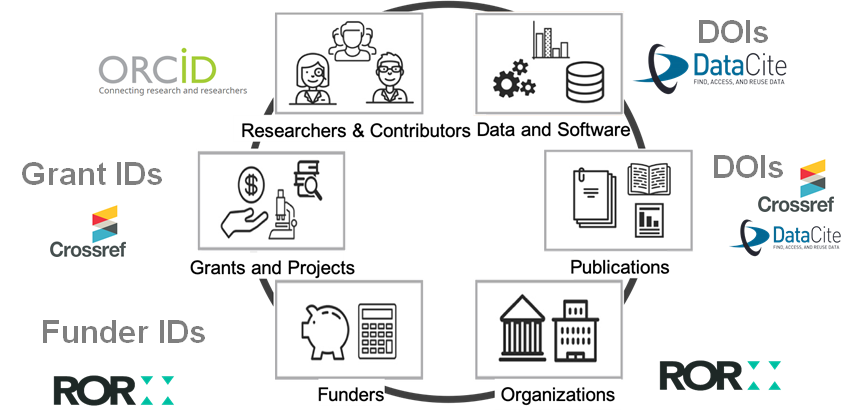
Connect different PIDs with each other through their metadata and you get a rich network of information. For instance, the metadata of a publication with a DOI may also include the authors' ORCID iDs and their home institutions' ROR IDs. As such, so far fragmented areas of research infrastructure become interconnected: journals, repositories, library datasets, research funders' databases and other systems. This way, information can be exchanged across systems, connections are better understood and workflows become easier or even automatized.
PIDs have benefits for all kinds of users
Funders
Funders can learn how their resources were used, for example when projects are given IDs. This makes reporting much easier.
Libraries and CRIS
Libraries and CRIS profit from PIDs' durability. In the metadata, they can link researchers to their outputs, their institution and other information. This supports cataloguing and reporting.
Developers
Developers appreciate how interoperable PIDs are, thanks to standardized metadata schemata and APIs provided by organizations such as DataCite. Cross-system work gets more manageable.
Researchers
Researchers profit from the increased visibility and findability of their work, be it research data, objects or publications. Thanks to contextualization with metadata, others' resources may be appraised more easily. An ORCID iD further allows researchers to give their information once and, ideally by way of automatization, provide it to all relevant institutions.
Publishers
PIDs increase the visibility and trustworthiness of publications. Publishers can, for instance, make an article's provenience transparent and unambiguous through PIDs for authors and data.
Further resources
Documents & posters
- Brown, J., Jones, P., Meadows, A., & Murphy, F. (2021). The PID-optimised Research Lifecycle. Zenodo. https://doi.org/10.5281/zenodo.4991733
- Brown, J., Jones, P., Meadows, A., & Murphy, F. (2022). PID-optimised workflows: A vision of a more efficient future. Zenodo. https://doi.org/10.5281/zenodo.7085489
- Dappert, A., Farquhar, A., Kotarski, R., & Hewlett, K. (2017). Connecting the Persistent Identifier Ecosystem: Building the Technical and Human Infrastructure for Open Research. Data Science Journal, 16. https://doi.org/10.5334/dsj-2017-028
- Erat, V., Fürst, E., & Puttinger, J. (2022). RIS Synergy: Persistent Identifiers. Zenodo. https://doi.org/10.5281/zenodo.7023003
- Söding, E., Pörsch, A., Kottmeier, D., Malinovskii, S., Wurz, J., & Lorenz, S. (2026). Enabling FAIR: What tools and services do we need to establish a coherent data ecosystem. Zenodo. https://doi.org/10.5281/zenodo.18556465
- Vierkant, P., Czerniak, A., Fischer, B. K., Genderjahn, S., Hagemann-Wilholt, S., Schrader, A., & Ziedorn, F. (2025). Vom Bedarf zur Umsetzung: Optimierungsansätze für PID-Systeme auf Basis von User Stories (1.0). Zenodo. https://doi.org/10.5281/zenodo.16262788
Videos
- Braukmann, R., Dohna, T., Bernal-Llinares, M., Bunakov, V., & Lambert, S. (2020). FREYA – The Power of PIDs. Zenodo. https://doi.org/10.5281/zenodo.3977942
- FAIR Data Austria. (2020-2026). Research Data Management in Austria [Playlist]. YouTube. https://youtube.com/playlist?list=PL8ZtwTwfkrV3NI6Qa6mETmQT3c8EwW-SO&si=L5HmmOvcieLRGZsg
- FDM Niedersachsen. (2025). Was sind Persistente Identifikatoren (PIDs)? YouTube. https://www.youtube.com/watch?v=sPTz2uvgFR4
- Fürst, E., Gómez Sánchez, A. F., Gumpenberger, C., Neff, S., Erat, V., & Harbich, M. (2022). An Exploration of Persistent Identifiers: Use, Value and Future. Phaidra. https://hdl.handle.net/11353/10.1459336
Websites
- PID Network Deutschland. Persistent Identifier (PIDs). https://www.pid-network.de/pids
- The PID Forum. https://pidforum.org/
- Dutch Digital Heritage Network. Persistent Identifier Guide. https://www.pidwijzer.nl/en